My favorite books from 2024
My favorite books in 2024 were a mix of fiction and nonfiction

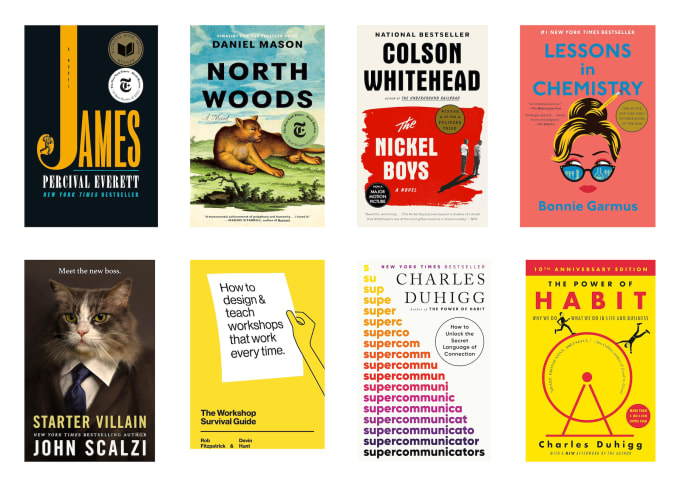
I read a little over 100 books in 2024. My goal every year is only 50 because I feel like you should read for joy not numbers, but it still feels weirdly like an accomplishment.
If you want to see the full list and all my reading, check me out on StoryGraph (preferred!) or Goodreads.
In this post, I'll cover my top 8, in no particular order. I've collected them into one list on Bookshop.org.
James by Percival Everett
James was one of the last books I read in 2024, and it really topped off the year. Percival Everett writes beautifully. This book touches on philosophical viewpoints and our hypocrisies, wrapped up in an emotional story with a complex inner struggle under the weight of slavery. It is humorous at times but also heartbreaking. This is a retelling of Huckleberry Finn from Jim's perspective.
When the enslaved Jim overhears that he is about to be sold to a man in New Orleans, separated from his wife and daughter forever, he decides to hide on nearby Jackson Island until he can formulate a plan. Meanwhile, Huck Finn has faked his own death to escape his violent father, recently returned to town. As all readers of American literature know, thus begins the dangerous and transcendent journey by raft down the Mississippi River toward the elusive and too-often-unreliable promise of the Free States and beyond.
North Woods by Daniel Mason
North Woods is a fascinating book set in the woods in rural Massachusetts. The book begins during in colonial times, then we see it slowly transform through time and experience the people that pass through. It's almost as if the woods and nature are the main character. It's also a lamentation on native plant loss. Honestly, I find it hard to truly describe what it feels like to read this book. It's like nothing I've ever read before.
When a pair of young lovers abscond from a Puritan colony, little do they know that their humble cabin in the woods will become home to an extraordinary succession of inhabitants. An English soldier, destined for glory, abandons the battlefields of the New World to devote himself to apples. A pair of spinster twins survive war and famine, only to succumb to envy and desire. A crime reporter unearths a mass grave, but finds the ancient trees refuse to give up their secrets. A lovelorn painter, a conman, a stalking panther, a lusty beetle: as each one confronts the mysteries of the north woods, they come to realize that the dark, raucous, beautiful past is very much alive.
Traversing cycles of history, nature, and even literature, North Woods shows the myriad, magical ways in which we’re connected to our environment and to one another, across time, language and space. Written along with the seasons and divided into the twelve months of the year, it is an unforgettable novel about secrets and fates that asks the timeless question: how do we live on, even after we’re gone?
The Nickel Boys by Colson Whitehead
The Nickel Boys confronts the brutal history of race and reform schools within a coming-of-age story. The story's structure wraps up in a brilliant ending, and I was left wanting more.
When Elwood Curtis, a black boy growing up in 1960s Tallahassee, is unfairly sentenced to a juvenile reformatory called the Nickel Academy, he finds himself trapped in a grotesque chamber of horrors. Elwood’s only salvation is his friendship with fellow “delinquent” Turner, which deepens despite Turner’s conviction that Elwood is hopelessly naive, that the world is crooked, and that the only way to survive is to scheme and avoid trouble. As life at the Academy becomes ever more perilous, the tension between Elwood’s ideals and Turner’s skepticism leads to a decision whose repercussions will echo down the decades.
Lessons in Chemistry by Bonnie Garmus
Lessons in Chemistry is both humorous and a challenging look at sexism in the workplace, especially STEM, while also delving into issues of motherhood and single-parenting. It stumbled a bit on representation, but the TV series actually improved on those issues.
Chemist Elizabeth Zott is not your average woman. In fact, Elizabeth Zott would be the first to point out that there is no such thing as an average woman. But it’s the early 1960s and her all-male team at Hastings Research Institute takes a very unscientific view of equality. Except for one: Calvin Evans; the lonely, brilliant, Nobel–prize nominated grudge-holder who falls in love with—of all things—her mind. True chemistry results.
But like science, life is unpredictable. Which is why a few years later Elizabeth Zott finds herself not only a single mother, but the reluctant star of America’s most beloved cooking show Supper at Six. Elizabeth’s unusual approach to cooking (“combine one tablespoon acetic acid with a pinch of sodium chloride”) proves revolutionary. But as her following grows, not everyone is happy. Because as it turns out, Elizabeth Zott isn’t just teaching women to cook. She’s daring them to change the status quo.
Starter Villain by John Scalzi
Starter Villain is a hilarious and lighthearted read. It's a great escape from daily life and mundane reads. The description alone gives you a feel for how wild this book goes:
Inheriting your uncle's supervillain business is more complicated than you might think. Particularly when you discover who's running the place.
Charlie's life is going nowhere fast. A divorced substitute teacher living with his cat in a house his siblings want to sell, all he wants is to open a pub downtown, if only the bank will approve his loan.
Then his long-lost uncle Jake dies and leaves his supervillain business (complete with island volcano lair) to Charlie.
But becoming a supervillain isn't all giant laser death rays and lava pits. Jake had enemies, and now they're coming after Charlie. His uncle might have been a standup, old-fashioned kind of villain, but these are the real thing: rich, soulless predators backed by multinational corporations and venture capital.
It's up to Charlie to win the war his uncle started against a league of supervillains. But with unionized dolphins, hyper-intelligent talking spy cats, and a terrifying henchperson at his side, going bad is starting to look pretty good.
In a dog-eat-dog world... be a cat.
The Workshop Survival Guide by Rob Fitzpatrick and Devin Hunt
The Workshop Survival Guide: How to design and teach educational workshops that work every time has helped me totally redesign the workshops I lead so that they are more engaging. I can't believe someone didn't cover this topic before. While it's written assuming in-person workshops, you can still modify most of the learnings to apply in a virtual environment.
Most workshops don't work. They fail to deliver real results and they fail to keep the audience energetic and engaged. They're stressful to run and painful to attend.
Designing and running a brilliant workshop is easier than you think. It's not about flashy showmanship or natural charisma. Instead, it's about following a set of clear, simple rules for structuring and arranging the day.
Supercommunicators by Charles Duhigg
Supercommunicators: How to Unlock the Secret Language of Connection was fascinating. I'm not always great at communication, and I found the strategies, tips, and stories in this book to be insightful and helpful. I initially borrowed it through my local library then purchased a copy because I know I'll need to refer back to it to remind me of those communication strategies.
We all know people who are capable of connecting with almost anyone. They’re the ones we love talking to, who we turn to for advice, who hear what we are trying to say and make us feel seen. What do they know about conversation that makes them so special?
The Power of Habit by Charles Duhigg
The Power of Habit: Why We Do What We Do in Life and Business was a really intriguing dive into how we create habits and break them. It has already helped me reframe some of my behaviors and shift them, particularly with eating and exercise. I highly recommend it if you've ever struggled eliminating a habit.
In The Power of Habit, award-winning business reporter Charles Duhigg takes us to the thrilling edge of scientific discoveries that explain why habits exist and how they can be changed. Distilling vast amounts of information into engrossing narratives that take us from the boardrooms of Procter & Gamble to the sidelines of the NFL to the front lines of the civil rights movement, Duhigg presents a whole new understanding of human nature and its potential. At its core, The Power of Habit contains an exhilarating argument: The key to exercising regularly, losing weight, being more productive, and achieving success is understanding how habits work. As Duhigg shows, by harnessing this new science, we can transform our businesses, our communities, and our lives.
This blog is reader-supported. If you buy a book from one of the links above, I'll earn some coffee money. You don't pay a higher price, and Bookshop.org supports independent booksellers.